Macro photography always feels a bit like stepping off the main road and discovering a hidden footpath you somehow walked past a hundred times. You don’t travel far, you don’t change countries or even rooms, but the scale shift is so dramatic that it rewires how you see everything afterward. What looks ordinary at arm’s length suddenly turns architectural, tactile, almost confrontational. The camera stops documenting objects and starts negotiating with them, light by light, millimeter by millimeter, and it demands patience in a way few other genres do.
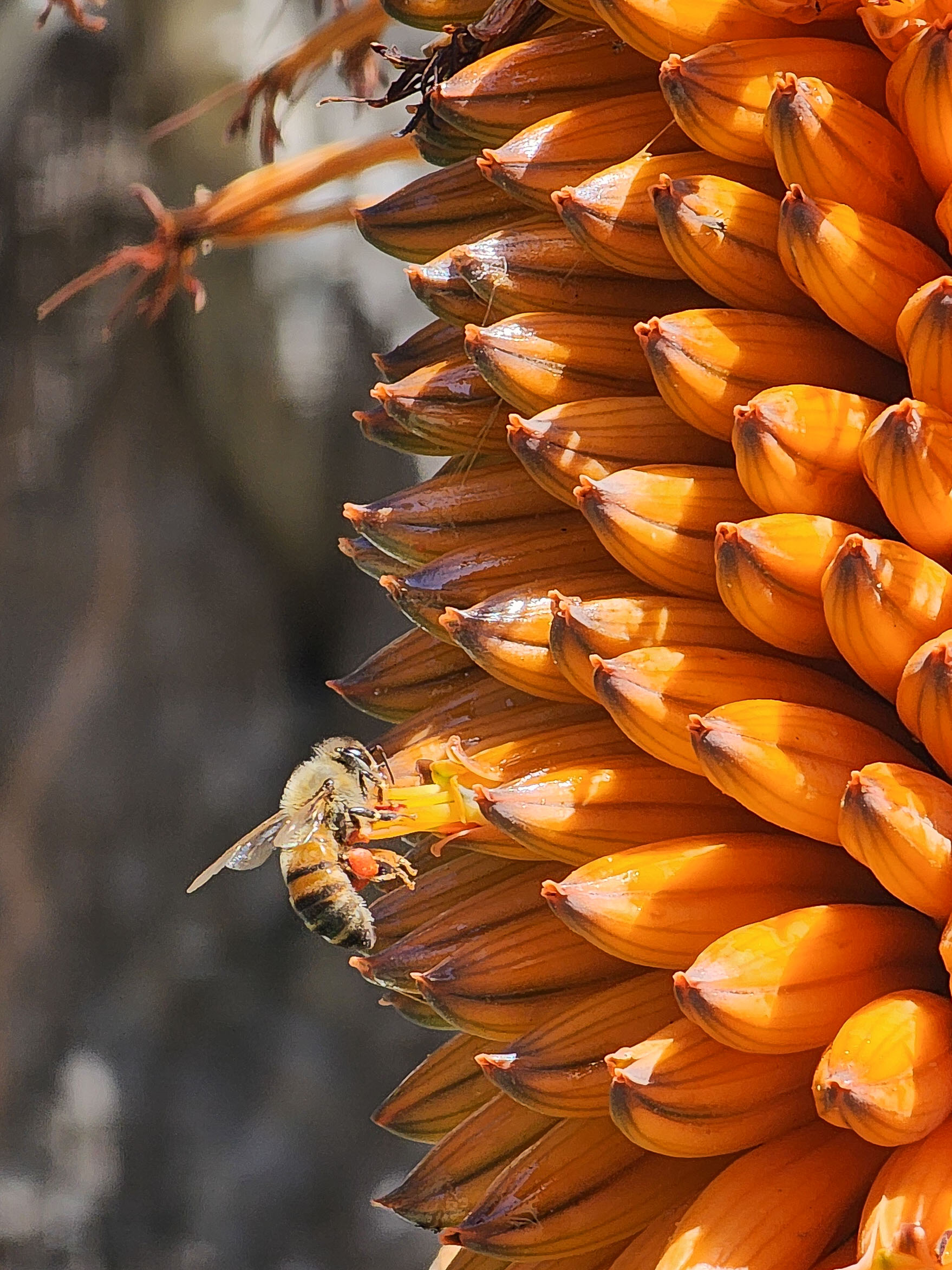
In the image here, a bee hovers at the edge of an orange flower head that suddenly feels massive, more like a clustered city than a plant. Each petal tip looks sculpted, slightly translucent, with tiny highlights catching along their edges, and the repetition pulls your eye inward until you notice the interruptions: a darker fold, a speck of pollen, the insect’s legs brushing against the surface. The background dissolves into a soft blur, muted and distant, which makes the subject feel suspended in its own universe. That shallow depth of field isn’t just an aesthetic trick, it’s part of the storytelling, isolating one precise interaction while the rest of the world politely steps aside. You can almost feel the stillness between movements, that split second where the bee decides whether to land or move on.
What macro photography teaches, slowly and sometimes stubbornly, is restraint. You stop chasing scenes and start waiting for them. Focus becomes a physical act, not just a setting, because the plane of sharpness is so thin that breathing wrong can undo the shot. Light matters more than gear talk ever admits; a slight shift in angle changes everything, turning texture into mud or revealing delicate structures you didn’t even know were there. It’s humbling, honestly, and a little addictive. You begin to notice how often the most interesting things are happening quietly, at knee height or lower, completely indifferent to whether anyone is watching.
Over time, macro work changes how you shoot everything else. You become more attentive to edges, transitions, and micro-gestures, even in wide scenes. It trains your eye to slow down, to respect complexity, to accept that not every frame needs to shout. Sometimes it just needs to whisper, up close, and let the viewer lean in on their own terms.
Upcoming technology conferences:
- International Compact Modeling Conference, July 30–31, 2026, Long Beach, California
- Israel Tech Week Miami (ISRTW), April 27–30, 2026, Miami, Florida
- Data Centre World London, 4–5 March 2026, ExCeL London
- Hannover Messe: Trade Fair for the Manufacturing Industry, 20–24 April 2026, Hannover, Germany
- DesignCon 2026, Feb. 24–26, Santa Clara Convention Center
- NICT at Mobile World Congress 2026, March 2–5, Barcelona
- Sonar Summit: A global conversation about building better software in the AI era, March 3, 2026
- Cybertech 2026: Proof That the Industry Is Finally Catching Up With Reality
- Chiplet Summit 2026, February 17–19, Santa Clara Convention Center, Santa Clara, California
- MIT Sloan CIO Symposium Innovation Showcase 2026, May 19, 2026, Cambridge, Massachusetts
Leave a Reply