This frame happened at a distance so small it almost felt impolite, the kind of closeness where you stop thinking in terms of subjects and start thinking in textures. A sunlit spike of orange aloe flowers wraps itself tightly around a vertical strip of rusted metal, each tubular bloom packed like scales or feathers, glowing somewhere between amber and burnt tangerine. The metal post cuts straight through the composition like a spine, rough, pitted, and flaking, its reddish-brown corrosion echoing the warm tones of the flowers while still resisting them. And then, slightly off-center, almost shy about it, a small snail clings to the metal edge, its shell spiraling in muted greens and browns, matte and weathered, as if it belongs equally to plant and iron. The background dissolves into pale, vertical streaks of dried leaves and soft blur, keeping everything quiet and out of the way so the eye stays right here, hovering on this strange meeting point.
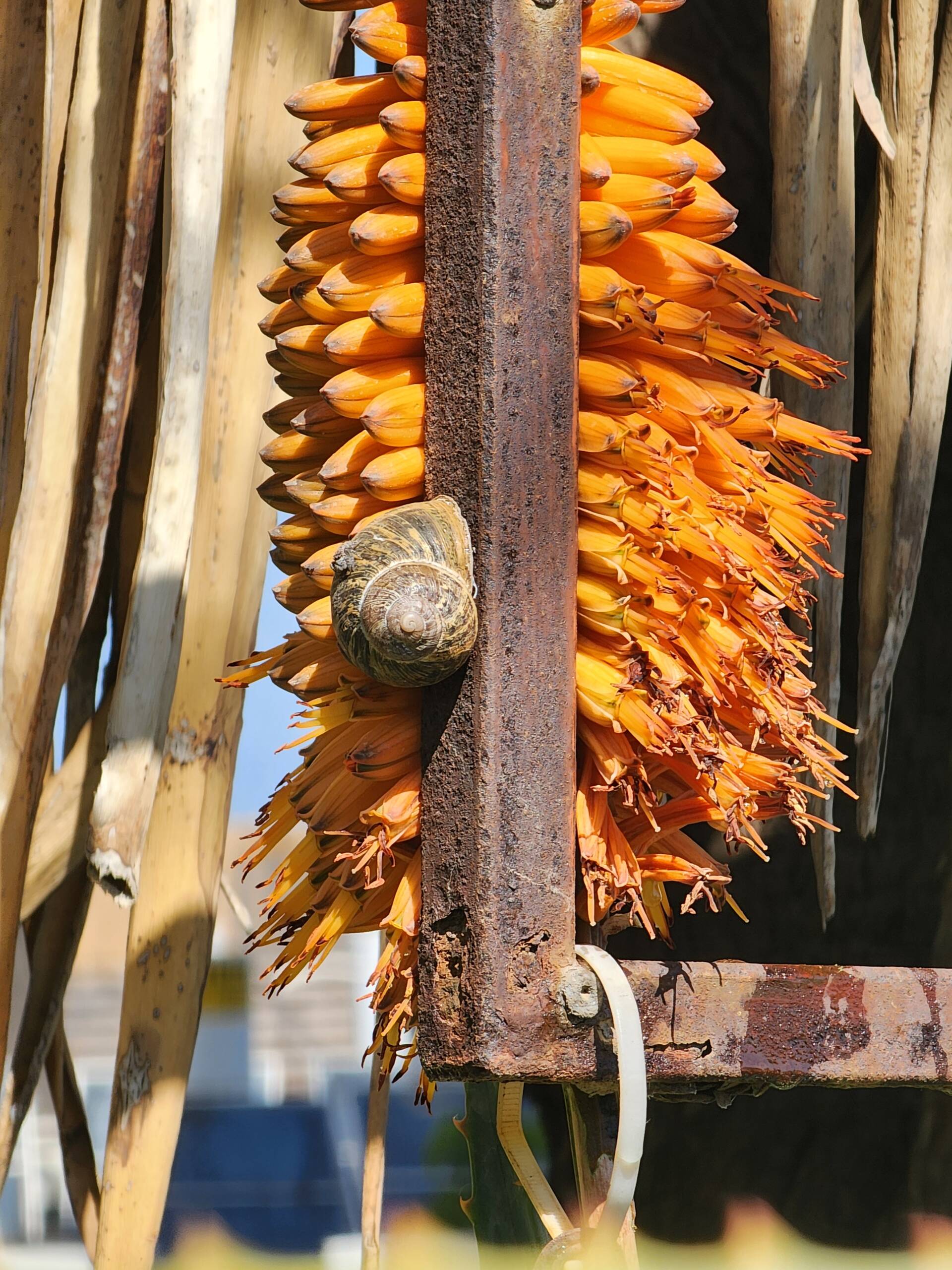
What pulled me in wasn’t just the contrast, though that helps. Organic softness pressing against industrial hardness, life growing literally around decay, all of it sounds poetic when you say it out loud, but in the viewfinder it’s much more physical. You notice how the flower tips are slightly frayed, some petals curling and drying at the ends, how the rust isn’t uniform but layered, cracked, almost scaly. The snail adds scale in the most literal way, a reference point that tells you how close you really are, how small this world is. Without it, the image could almost read as abstract. With it, the scene snaps into reality, and suddenly you’re aware of time passing very slowly, one millimeter at a time.
Macro photography often gets reduced to sharpness tests and magnification ratios, but moments like this are why I keep coming back to it. At this distance, composition becomes less about framing and more about negotiation. A few millimeters left or right and the shell either disappears into shadow or flattens against the metal. Light matters in a very unforgiving way; harsh sun turns texture into noise, but here it skims just enough to carve depth into the rust and let the flowers glow without blowing out. You’re not hunting drama, you’re waiting for balance, and sometimes that means standing there longer than feels reasonable, hoping the snail doesn’t decide to wander off mid-thought.
I like how this image refuses to be purely botanical or purely abstract. It sits somewhere in between, a small reminder that macro isn’t about making tiny things look big, but about making familiar things strange again. A fence post becomes a landscape, a flower spike becomes architecture, a snail becomes a character with its own quiet presence. You walk away from shots like this a little more alert, noticing cracks in paint, patterns in rust, the way life keeps inserting itself into the most unlikely places. That awareness tends to stick with you longer than the photo itself, which is probably the best outcome I can ask for.
Leave a Reply